
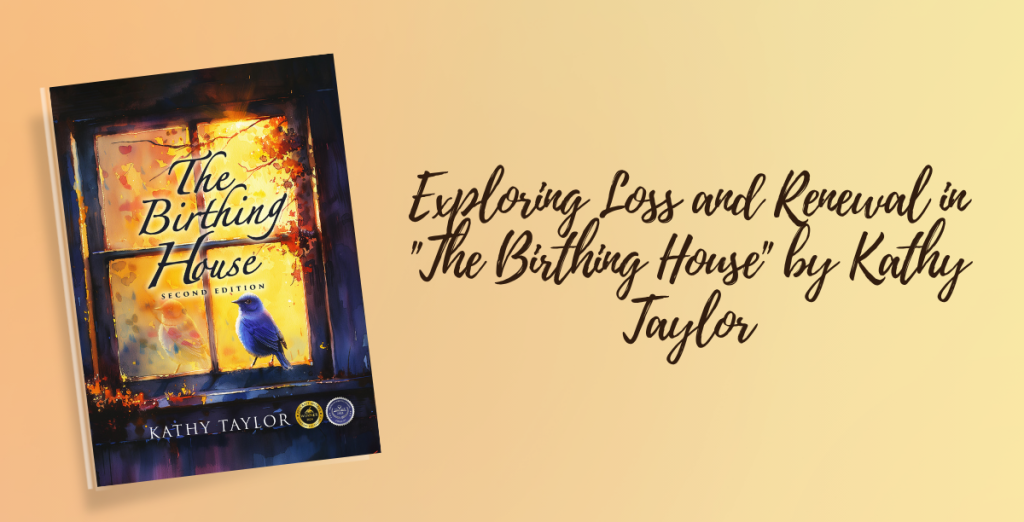
Kathy Taylor’s The Birthing House is a brilliant literary exploration of loss, healing, and the search for meaning in the aftermath of life’s most painful experiences. With a unique narrative structure that weaves together two timelines, Taylor takes readers on a journey of self-discovery, cultural immersion, and emotional rebirth. Set in the picturesque German town of Marburg, The Birthing House follows the emotional journey of Clare, a woman grappling with grief after the loss of her unborn child, and later, the death of her father. Through her personal struggles, the novel delves into universal themes of identity, belonging, and the complexities of language and memory.
The novel’s backdrop is as much a character as Clare herself. Marburg, with its cobblestone streets, ancient buildings, and fairy-tale charm, holds its own stories of pain and struggle. The town, rich with history, offers a sense of mystery and wonder, yet also serves as a mirror for Clare’s emotional transformation. Marburg is not just a place of physical relocation but represents the internal landscape that Clare must come to terms with as she confronts her grief and attempts to rebuild her life. The town becomes a site of renewal, where past wounds are revisited, and new connections are formed.
The central location of the novel, Das Haus, the house Clare rents in Marburg, is both a sanctuary and a catalyst for Clare’s emotional journey. The house belongs to a woman named Hannah, who, although absent, leaves behind a legacy of memory in the form of photographs, objects, and plants. As Clare occupies the space, the house becomes a repository for her thoughts, struggles, and reflections. There is a profound sense of continuity in the house, a sense that the past and the present are forever interwoven. The house becomes a living, breathing entity—one that shapes Clare’s process of healing and self-discovery.
Taylor’s prose is both lyrical and intimate, offering an insight into Clare’s internal world without ever feeling intrusive. As Clare navigates the streets of Marburg, she is also navigating the labyrinth of her grief and her search for meaning. Through Clare’s eyes, we experience the tension between the foreignness of the German language and the comfort it brings as she slowly immerses herself in it. The way language shapes identity is a recurring theme in the novel. The German language, with its precise, efficient vocabulary, contrasts sharply with the fluidity and complexity of Clare’s emotions. As Clare learns new words, the novel suggests that language has the power to bridge emotional divides and foster connection. It’s not just the physical language that she learns, but the emotional language of her grief that she must come to terms with.
At the heart of The Birthing House is the notion of renewal. The title itself is a metaphor for the process of birth, not just in the literal sense but as a symbol of emotional rebirth. The act of writing becomes a form of self-birthing for Clare, a way for her to give voice to her pain and work through her grief. Her journal entries, which appear throughout the novel, are an intimate look at her process of healing. In a particularly poignant scene, Clare writes in her journal, “We write to give birth to ourselves.” This line, inspired by the epigraph from Catalina Sastre, encapsulates the novel’s central idea that writing—and by extension, storytelling—is a form of personal reinvention. In the act of telling our stories, we give birth to our own identities and find ways to move beyond the pain that once defined us.
The grief that Clare experiences is complicated by the backdrop of her relocation to Germany. In the midst of her personal loss, she is also adapting to a new country, a new culture, and a new life. This sense of dislocation is amplified by the internal dislocation she feels after the miscarriage and her father’s death. The novel shows how the pain of loss can often feel like a betrayal of time itself. Just as Clare attempts to reconnect with her life in Marburg, she is haunted by ghosts from her past. But rather than run away from these ghosts, she embraces them, understanding that they are part of her own narrative. This dual sense of loss—the personal and the cultural—helps to deepen the novel’s emotional impact. Taylor’s characters wrestle with the idea of displacement, both physical and emotional, and the novel’s nuanced portrayal of this struggle makes it a powerful commentary on the human condition.
The idea of adaptation and resilience is also explored through Clare’s relationship with her son, Willy. His innocence and exuberance serve as a counterpoint to Clare’s more melancholic reflections. Through Willy, Clare finds a path back to joy, even if it is fleeting. The bond between mother and son is a central theme in The Birthing House, illustrating how grief and joy can coexist in the same space. Willy, in his own innocent way, helps Clare to reconnect with life, showing her that even in the most painful of times, there is still room for light and hope.
Taylor’s masterful storytelling, combined with her rich descriptions of place, character, and emotion, makes The Birthing House a must-read for those interested in literature that explores themes of loss, healing, and the power of self-discovery. The novel’s intricate narrative structure—moving back and forth between two timelines—allows readers to explore the complexity of grief and the slow, sometimes painful, process of moving forward. By the end of the novel, Clare’s journey is one of hope and transformation. Like Germany, itself, she cannot erase her past. She learns to live with it and find new meaning in her life. The Birthing House is a testament to the resilience of the human spirit and the ways in which, even in our darkest moments, we can find the strength to give birth to ourselves.