
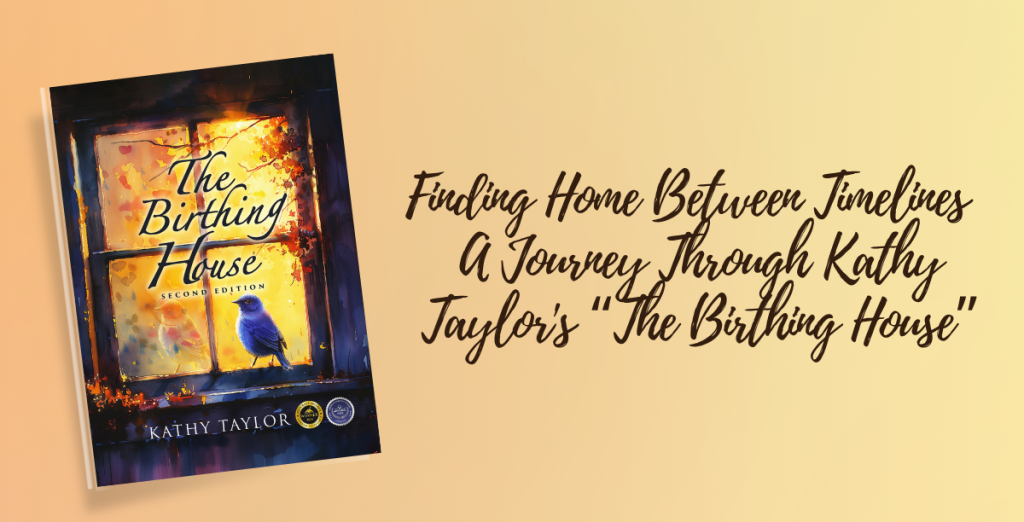
Kathy Taylor’s novel The Birthing House is not just a story. It’s a mirror, a diary, a map, and at times, a love letter to grief, motherhood, memory, and place. Set in the picturesque, almost fairytale-like town of Marburg, Germany, Taylor constructs a deeply immersive narrative that blurs the lines between past and present, fiction and memory, physical relocation and internal migration. It’s a book that slowly seeps into your consciousness, one vivid image at a time.
At the heart of the novel is Clare Muller, a literature professor and writer who finds herself at a crossroads in life. Having recently lost her father, she returns to Marburg with her husband, Stefan, for a sabbatical year that promises both professional fulfillment and emotional space. But this isn’t Clare’s first time in Germany. The story unfurls in two parallel timelines—the 1980s, when she first came to Marburg as a young mother, grieving a miscarriage and trying to find her footing in a foreign land, and the year 2000, as she revisits these emotional landmarks as an older woman still carrying the weight of loss.
Taylor’s structure is deceptively simple but emotionally profound. The two timelines are woven together seamlessly, and they don’t merely echo one another—they converse. The younger Clare, full of determination but shaken by grief, grapples with learning to mother her son Willy in an unfamiliar country. The older Clare, more introspective and pained by the recent loss of her father, revisits the very spaces that once challenged and reshaped her. There’s a circularity in Clare’s journey—a narrative symmetry that gives the novel a haunting and poetic rhythm.
What makes The Birthing House exceptional is its quiet intensity. Taylor writes with a kind of intimacy that feels like she’s peeling away the layers of a soul. The scenes are rich in sensory detail. We can smell the fresh Schwarzbrot Clare buys from the local bakery, feel the texture of her leather-bound journal, and hear the ticking of the grandfather clock that anchors her during sleepless nights. Taylor makes Marburg come alive not just as a setting, but as a character in its own right. The town doesn’t just hold memories; it shapes them.
The titular house—Hannah’s house, where Clare and Stefan live during their sabbatical—becomes both sanctuary and catalyst. It is filled with plants, books, photographs, and the spirit of a woman Clarehas not yet met but feels deeply connected to. Clare writes in a journal, speaking to Hannah as though she were a confidante, unearthing layers of her own identity through these imagined conversations. The house is a space of rebirth, as the title suggests, where Clare slowly gives birth to a new version of herself.
Taylor’s prose is lyrical yet grounded, poetic without being indulgent. She balances introspection with action, and philosophical musings with deeply human moments. Clare’s relationship with her son Willy, particularly in the 1980s timeline, is rendered with such tenderness and realism that you feel you’re eavesdropping on something sacred. The small rituals—feeding ducks, discovering German words, playing on the playground—are imbued with symbolic weight. These aren’t just memories; they are the threads that stitch Clare’s fragmented self back together.
One of the most poignant aspects of the novel is its treatment of grief. Taylor doesn’t romanticize loss, nor does she drown in it. Instead, she treats it as a companion—sometimes quiet, sometimes overwhelming, but always present. Clare’s grief over her miscarriage, and later, over her father’s death, doesn’t follow a neat arc of healing. It lingers, morphs, reappears. There is no final catharsis, no dramatic closure—only the slow, aching realization that life must go on, not in spite of the pain, but with it.
The novel also touches on themes of cultural dislocation and adaptation. Clare, an American in Germany, doesn’t just navigate language barriers or bureaucracy. She encounters subtle tensions and misunderstandings that highlight how identity is both reinforced and challenged by place. Her interactions with locals, fellow expatriates, and the landscapes around her serve as metaphors for her internal evolution.
Ultimately, The Birthing House is about the stories we tell ourselves to make sense of our lives. Clare is both narrator and character, author and reader of her own experience. Her journaling, her teaching, even her dreams become vehicles for processing reality. Taylor’s brilliance lies in how she lets us into Clare’s mind without making us feel like outsiders. We walk beside her, not behind.
This is not a book you rush through. It invites you to linger, to reread sentences, to sit with your own memories as you turn the pages. It’s deeply personal, yet universal. Anyone who has experienced loss, moved through different cultures, or struggled to reconcile the past with the present will find something in Clare’s story that speaks to them.
The Birthing House isn’t just about birth in the literal sense. It’s about the many ways we are born and reborn throughout our lives. Through pain, through love, through place, through time. Kathy Taylor reminds us that the past is never really past, and that sometimes, going back is the only way forward.