
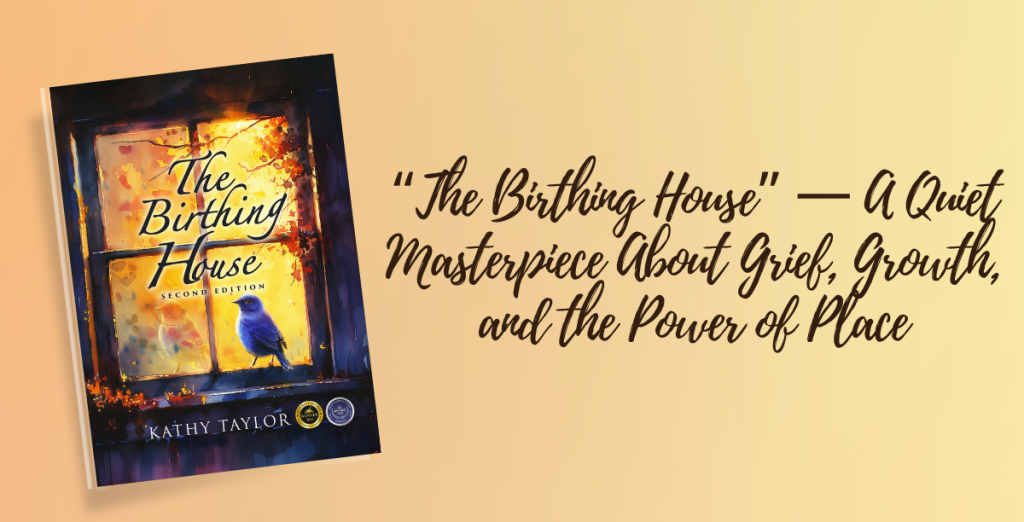
There’s a special kind of story that doesn’t rely on shock or spectacle to capture you. It doesn’t shout. Instead, it breathes. It gently takes your hand, walks you through lived memories, and invites you to listen closely. Kathy Taylor’s The Birthing House is exactly that kind of story—a quietly powerful novel that lingers long after the final page.
Set against the poetic backdrop of Marburg, Germany, this novel follows Clare Muller, a professor and writer navigating two defining periods of her life—once in the 1980s, and again in 2000. But this isn’t just a book about travel or midlife reflection. It’s a story about loss, belonging, and the stories we carry inside us.
A Story Told in Two Mirrors
Clare arrives in Germany with her husband Stefan and a heart still aching from her father’s recent death. Twenty years earlier, she came to this same place carrying another kind of grief—the loss of an unborn child. The dual timelines Taylor weaves are seamless and poetic, capturing Clare in two stages of her life: as a young mother trying to stay afloat and as a mature woman trying to feel again.
What’s remarkable is how natural these transitions feel. Taylor doesn’t rely on dramatic time jumps or gimmicks. Instead, memories gently surface like ripples in still water—pulled from smells, streets, or sudden silences.
The House That Holds Her
The “Birthing House” isn’t just a title—it’s a living, breathing character in the story. Clare and Stefan rent the home of a woman named Hannah while she’s away for a year. Hannah’s presence is felt in every detail: the plants, the photos, the books. Clare begins to write again in a journal her late father gave her, slowly unpacking her grief and reconnecting with herself.
The house becomes both sanctuary and mirror. Through its rooms and routines, Clare begins to feel again—to write, to remember, to heal.
Writing in Pencil: A Gentle Metaphor for Life
One of the most moving elements in the novel is Clare’s habit of writing in pencil. There’s a quiet symbolism to it—writing not in ink, not in permanence, but with something that can be changed, softened, erased. That choice speaks volumes about how we process memory and grief. Nothing is final. Everything, even loss, evolves with time.
Taylor’s prose is rich with these gentle metaphors. She never tells us how to feel. She lets Clare’s voice—subtle, thoughtful, sometimes scattered—guide us naturally through the emotional terrain.
Memory as a Map
Much of Clare’s healing comes through the physical and emotional act of remembering. Whether it’s buying bread from the same Bäckerei she once visited with her young son, or revisiting the riverside where they fed ducks, every small act opens a floodgate.
But memory here is not just nostalgic. It’s layered. Sometimes it comforts, other times it wounds. Taylor doesn’t romanticize the past—she shows how fragile and complex it can be.
Cross-Cultural Threads
Another thread in the book that stood out was the nuanced portrayal of living between cultures. Clare is American but finds a kind of home in Marburg, even when it’s uncomfortable. Taylor captures the small, intimate moments of cultural adaptation so well—from the way language can both connect and isolate, to the quiet joy of learning the rhythm of a new place.
It reminded me of how universal stories of relocation are—not just the physical move, but the emotional reckoning that comes with letting go of what you expected and finding meaning in what unfolds.
The Echo of Motherhood
Motherhood in The Birthing House isn’t treated as a static role—it’s evolving, raw, and layered with joy, loss, and longing. Clare’s experiences as a young mother and as a woman grieving a child she never got to raise are woven throughout the novel. Taylor doesn’t idealize or simplify it; she shows how motherhood can be full of contradictions—nurturing and draining, fulfilling and lonely, present and absent. Through Clare’s memories of her son Willy and her reflections on what might have been, the novel offers a heartfelt meditation on maternal identity over time.
Memory as a Living Thing
In Taylor’s hands, memory isn’t just something that happens to Clare—it’s something she participates in. The streets of Marburg, the scent of bread, a particular photograph—all become portals that blur the line between past and present. There’s a strong sense that we carry our memories physically, not just mentally, and that they have the power to both wound and restore. This living, breathing portrayal of memory is one of the novel’s quiet strengths.
The Feminine Presence of the House
The house Clare inhabits—Hannah’s house—carries a distinctly feminine energy. It’s not haunted in the horror-story sense, but it hums with the life and rhythm of its absent owner. Plants, art, journals, kitchen tools—each detail reflects a thoughtful, lived-in world that Clare slowly steps into. It becomes a space of transformation, a temporary womb where Clare can safely grieve, write, and begin again. Taylor’s depiction of the house as a silent mentor or guide is subtle, but profound.
Writing as Rebirth
Clare’s journal becomes more than a diary—it’s a second voice, a confidant, a space where she can reclaim agency. Writing in pencil, she rediscovers the act of storytelling not as an academic exercise but as a personal lifeline. Her grief, her cultural reflections, her encounters with Hannah’s world—all are processed through words. In this way, The Birthing House becomes a book about books, about the power of writing not just to remember, but to reimagine, to rebuild, to rebirth.
A Novel of Quiet Power
If you’re looking for a page-turner full of suspense or plot twists, The Birthing House might not be your cup of tea. But if you’re craving something real—something that sits with you and stirs something deep—this book is a gem.
Kathy Taylor writes with the kind of emotional intelligence and lyrical grace that is hard to teach. Her characters feel lived-in. Her prose is grounded and elegant. And her story reminds us that even after deep loss, there is room to grow, to write, and to be reborn.
Whether you’re a mother, a daughter, a writer, or simply someone who’s ever been a stranger in a new place, Clare’s story will resonate.
The Birthing House is not just about giving birth to a child—it’s about giving birth to oneself. Again and again.